Package Information
- Last Updated
- Minimum Typst Version
- 0.14.1
- Authors
- Naaktgeboren, C.
- Categories
- modelscripting
- Disciplines
- theology
- Dependencies
- @preview/tidy:0.4.3
1. Get the package
Download the package using the TPIX CLI:
tpix get @preview/blindex:0.4.02. Import in your Typst file
Add this to your .typ file:
#import "@preview/blindex:0.4.0": *Blindex: index-making of Biblical literature citations in Typst
Blindex (blindex:0.4.0) is an index-generating Typst package taylored to some specific needs
of biblical literature (i) quoting, (ii) referencing, and (iii) indexing. Target audience
includes authors of any area of knowledge that make frequent use of biblical literature
citations in their work, including theologians, historians, philosophers, and classic linguists
alike.
Blindex user-facing functions are highly-customizable. Check the API documentation for details.
Index Sorting Options
The generated indices are gathered and sorted by Biblical literature books, which can be ordered
according to various Biblical literature book ordering conventions, including:
"code"-- All registered Biblical literature books."USX"-- Unified Scripture XML: All registered Biblical literature books. Default."LXX"-- The Septuagint;"Greek-Bible"-- Septuagint + New Testament (King James);"Hebrew-Tanakh"-- The Hebrew (Torah + Neviim + Ketuvim);"Hebrew-Bible"-- The Hebrew Tanakh + New Testament (King James);"Protestant-Bible"-- The Protestant Old + New Testaments;"Catholic-Bible"-- The Catholic Old + New Testaments;"Orthodox-Bible"-- The Orthodox Old + New Testaments;"Oecumenic-Bible"-- The Jewish Tanakh + Old Testament Deuterocanonical + New Testament;
Biblical Literature Abbrevations
It is common practice in biblical literature referencing to refer to biblical literature books
by their abbreviations rather than through standard bibliographical methods, since biblical
literature commonly gathers books within a larger book. Practice shows that abbreviation
conventions are language- and tradition- dependent. Therefore, blindex usage reflects this
fact, while offering a way to input arbitrary language-tradition abbreviations, by extending the
lang/ source tree.
Language and Traditions (Variants)
The blindex implementation generalizes the concept of tradition (in the context of
biblical literature book abbreviation bookkeeping) as language variants, since the software
can have things such as a "default" of "n-char" variants.
As of the current release, supported languages include the following few ones:
| Language | Variant | Description | Name |
|---|---|---|---|
| English | USX | USX abbreviations | en-USX |
| English | 3-char | A 3-char abbreviations | en-3 |
| English | Logos | Used in logos.com |
en-logos |
| Portuguese (BR) | Protestant | Protestant for Brazil | br-pro |
| Portuguese (BR) | Catholic | Catholic for Brazil | br-cat |
| French | Œcuménique (TOB) | Ecumenical in French | fr-TOB |
Additional language-variations can be added to the lang/ source tree by the author and/or by
pull requests to the dev branch of the development repository
https://github.com/cnaak/blindex.typ, i.e., not the Typst packages one.
Low-Level Indexing Command
The blindex library has a low-level index entry marking function #blindex(abrv, lang, entry), whose arguments are (abbreviation, language, entry), as in:
"the citation..." #blindex("1Thess", "en-logos", [1.1--3])
Following the usual index making strategy in Typst, this use of the #blindex command only adds
the index-marking #metadata in the document, without producing any visible typeset output.
Biblical literature index listings can be generated (typeset) in arbitrary amounts and locations
throughout the document, just by calling the user #mk-index command:
#mk-index()
Optional arguments control style and sorting convention parameters, as explained in the API.
Higher-Level Quoting-Indexing Commands
The library also offers higher-level functions to assemble the entire (i) quote typesetting,
(ii) reference typesetting, optional (iii) bibliography, and (iv) indexing entrying of the
passage. Styling options offer maximum control over the output formatting, as well as allows
for document-wide standardization through function redefinitions through with, according to
typst documentation.
Higher-level quoting-referencing-indexing functions are #ind-inl(...), #ind-blk(...),
respectively for inline and block quoting of Biblical literature, with automatic
indexing and optional bibliography citation. There's also a helper #ver[...] function for
convenient verse number formatting, mostly aimed at being used within block quotes.
Check the API documentation
for details.
Examples
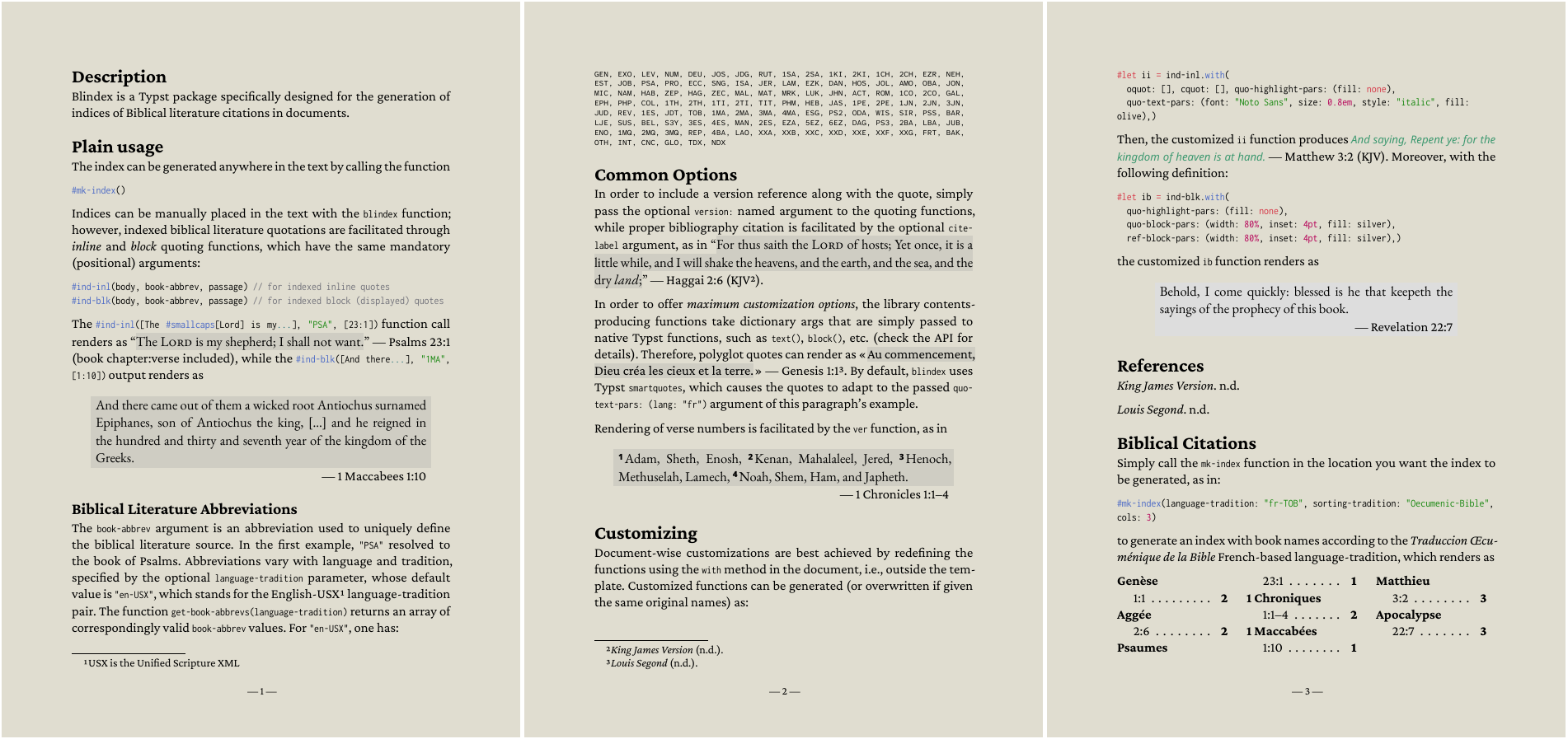
The thumbnail.typ
briefly showcases likely common package workflows. It renders as
Brief Release Summary
0.1.0- initial release0.2.0- improved usability and configurability0.3.0- breaking re-casing (to camel-case) of user-facing definitions0.4.0- Full API refactoring and documentation
Citing
This package can be cited with the following bibliography database entry:
blindex-package:
  type: Web
  author: Naaktgeboren, C.
  title:
    value: "Blindex: Index-making of Biblical literature citations in Typst"
    short: "Blindex: Index-making in Typst"
  url: https://github.com/cnaak/blindex.typ
  version: 0.4.0
  date: 2026-03