
lookscanned
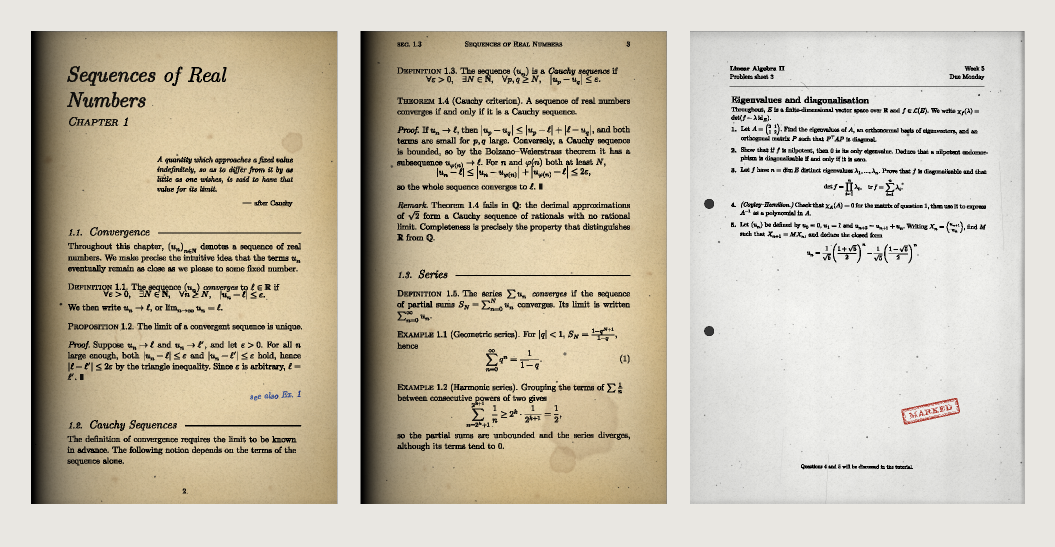
@previewMake documents look scanned, photocopied, faxed or typewritten, powered by WASM.
lookscanned
Make a Typst document look scanned, photocopied, faxed or typewritten: paper grain, foxing, stains, dust, scanner shadows, drum bands, fax lines and bleeding ink. Textures and randomness come from a small WebAssembly plugin; the effects are applied by Typst, so:
- text and equations stay real text: selectable, searchable, accessible;
- the layout does not move: line and page breaks are those of the clean document;
- rendering is deterministic: the same
seedalways gives the same PDF.
Quick start
#import "@preview/lookscanned:0.1.0"

#show: lookscanned.scan.with(preset: "old-paper", seed: 3)

= Cauchy sequences
A sequence $(u_n)$ is a _Cauchy sequence_ if for every $epsilon > 0$ there
exists $N$ such that $abs(u_p - u_q) <= epsilon$ for all $p, q >= N$.
Place scan after your set page rules. With a template whose rule must come last, such as mousse-notes, place
scan just before it:
#show: lookscanned.scan.with(preset: "old-paper", edges: (binding: true))
#show: style
Presets
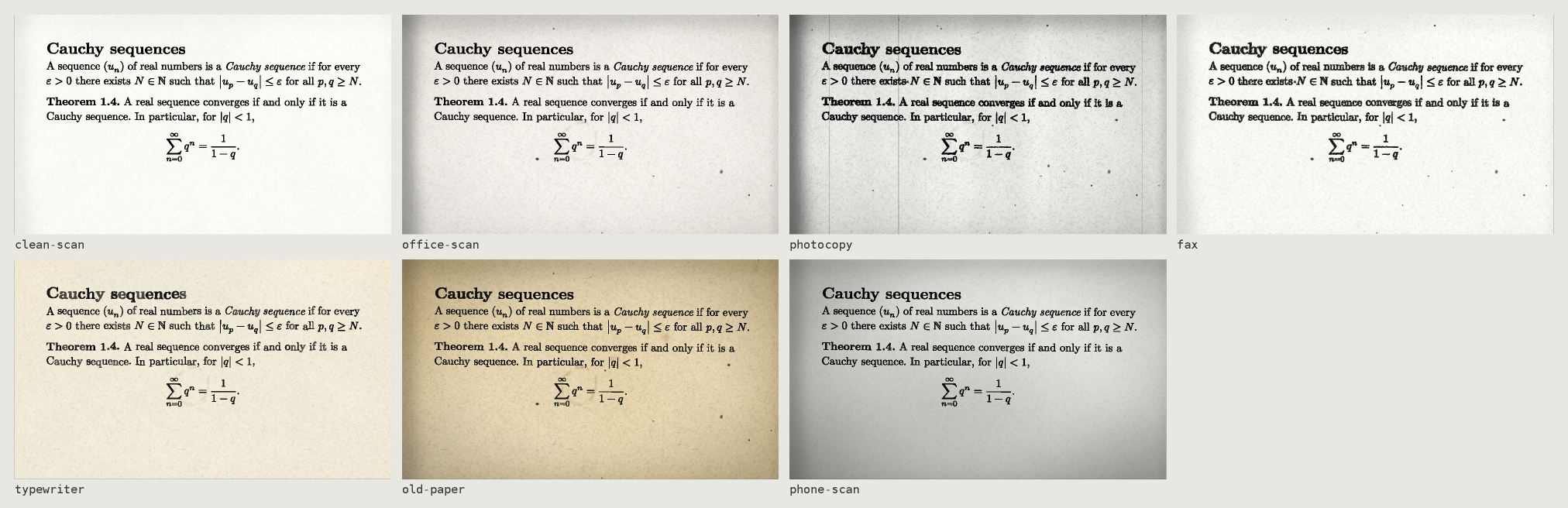
| Preset | Look |
|---|---|
"clean-scan" |
Off-white paper, little grain, minimal rotation |
"office-scan" (default) |
Moderate grain, edge shadow, slight drift between pages |
"photocopy" |
Heavy bleed, drum bands, dust, scratches |
"fax" |
Transmission lines, per-word jitter, low legibility |
"typewriter" |
Per-character jitter, uneven inking, worn ribbon |
"old-paper" |
Yellowing, foxing, stains, vignette |
"phone-scan" |
Strong rotation, uneven lighting |
lookscanned.presets is a plain dictionary; any dictionary of the same shape can be passed as preset.
Settings
intensity scales every amount, angle and offset (0 disables the effect, 1 is the preset, > 1 exaggerates).
seed selects the variant. Every other setting belongs to a theme; omitted keys keep the preset's value:
#show: lookscanned.scan.with(
  preset: "office-scan",
  intensity: 0.7,
  seed: 7,
  paper: (color: rgb("#f4efe4"), grain: 0.4, aging: 0.2, fibers: 0),
  stains: (color: rgb("#8b5a2b"), amount: 0.3, size: (min: 2mm, max: 15mm), dust: 0.5, scratches: 0),
  ink: (bleed: 0.4, fade: 0.2, legibility: 0.8, wear: 0, ghosting: false),
  skew: (page-rotation: 0.6deg, line-jitter: 0.15deg, char-jitter: 0pt, drift: 0.3),
  edges: (shadow: 0.5, vignette: 0.3, uneven: 0, binding: false, punch-holes: false),
  scanner: (lines: 0, bands: 0),
  quality: (resolution: 150, tile: true, granularity: "line"),
)
| Key | Effect |
|---|---|
paper.grain, aging, fibers |
Grain and mottling; yellowing and foxing; paper fibres |
stains.amount, size, color |
Blotches, coffee rings and splatters |
stains.dust, scratches |
Specks and hairs, long scratches on the scanner glass |
ink.bleed |
Ink spreading into the paper: glyphs grow unevenly |
ink.fade |
Uneven inking per word (per character with "char") |
ink.legibility |
1 sharp to 0 barely readable: halo, dropouts, fading |
ink.wear |
Pinholes and dropouts inside the glyphs |
ink.ghosting |
Faint offset copies. Off by default: text extractors read them |
skew.page-rotation, drift |
Maximum rotation per page; 1 makes it wander slowly across pages |
skew.line-jitter, char-jitter |
Rotation per block or word; offset per word or character |
edges.* |
Edge shadow, vignette, uneven light, binding shadow, two ISO 838 punch holes |
scanner.lines, bands |
Fax lines, photocopier bands |
quality.resolution, tile |
Texture DPI; one shared grain tile for all pages |
quality.granularity |
"page", "line", "word" or "char" jitter |
Unknown themes or keys and values of the wrong type stop compilation with an explicit error.
Pages, regions and decorations
// Page-level effects for the pages spanned by the body.
#lookscanned.page(stains: (amount: 0.8), skew: (page-rotation: 2deg))[
  = Appendix: tables
]

// Text effects on a single block, without the global rule.
#lookscanned.region(preset: "typewriter")[
  *Proof.* Let $epsilon > 0$ …
]

#lookscanned.stamp("Library copy", color: rgb("#5b3a8c"), angle: -12deg)
#lookscanned.scribble(body: "see Thm 1.4", color: blue)  // wobbly italic
#lookscanned.scribble(width: 3cm)                       // scrawl
#lookscanned.stain(at: (x: 60%, y: 20%), size: 25mm)
stamp and scribble also accept at: (x: .., y: ..) for absolute placement.
Raw textures
#set page(background: lookscanned.texture("paper", seed: 3, color: rgb("#f0e6d2"), grain: 0.5))
#set page(foreground: lookscanned.texture("dust", seed: 3, amount: 0.4))
Kinds: "paper", "grain", "toner", "ink", "stains", "dust", "lines", "edges". Without width and
height, a texture takes the page size.
Limitations
- No true blur or perspective: bleed and blur use textured strokes;
phone-scanuses rotation and lighting only. "line"granularity rotates whole blocks (Typst has no per-line hook)."word"boxes words, which prevents hyphenation in justified text;"char"shifts characters vertically only.- Fraction bars and radical lines in equations are shapes and do not bleed.
scanreplaces the pagebackgroundandforeground.- Page-sized textures need a fixed page height; with
height: auto, only paper colour and grain are drawn. - Poppler-based viewers draw the textured ink outline as plain ink. Typst 0.15.1 cannot export textured text to PNG; export a PDF and convert it with Ghostscript.
Documentation
Full guide, API and settings reference, and internals: https://kornstein.github.io/lookscanned/.
Credits
Part of the Rust texture algorithms and most of the Typst code were written by hand. The rest was built with Claude.
The text remains real text, but a "scanned" document is harder to read: keep a clean version available
(intensity: 0). This package is meant for design, fiction, games, props and OCR testing; do not use it to forge
documents.