Package Information
- Last Updated
- Authors
- Samyak Jain
- Categories
- report
- Dependencies
- @preview/showybox:2.0.2
Preview
1. Get the package
Download the package using the TPIX CLI:
tpix get @preview/nova-pset:0.1.02. Initialize from template
Create a new project from this template:
typst init @preview/nova-pset:0.1.0The nova-pset Package
Version 0.1.0
Homework template for STEM coursework and problem sets. Spin-off of adaptable-pset with some modifications and additional functions.
Examples
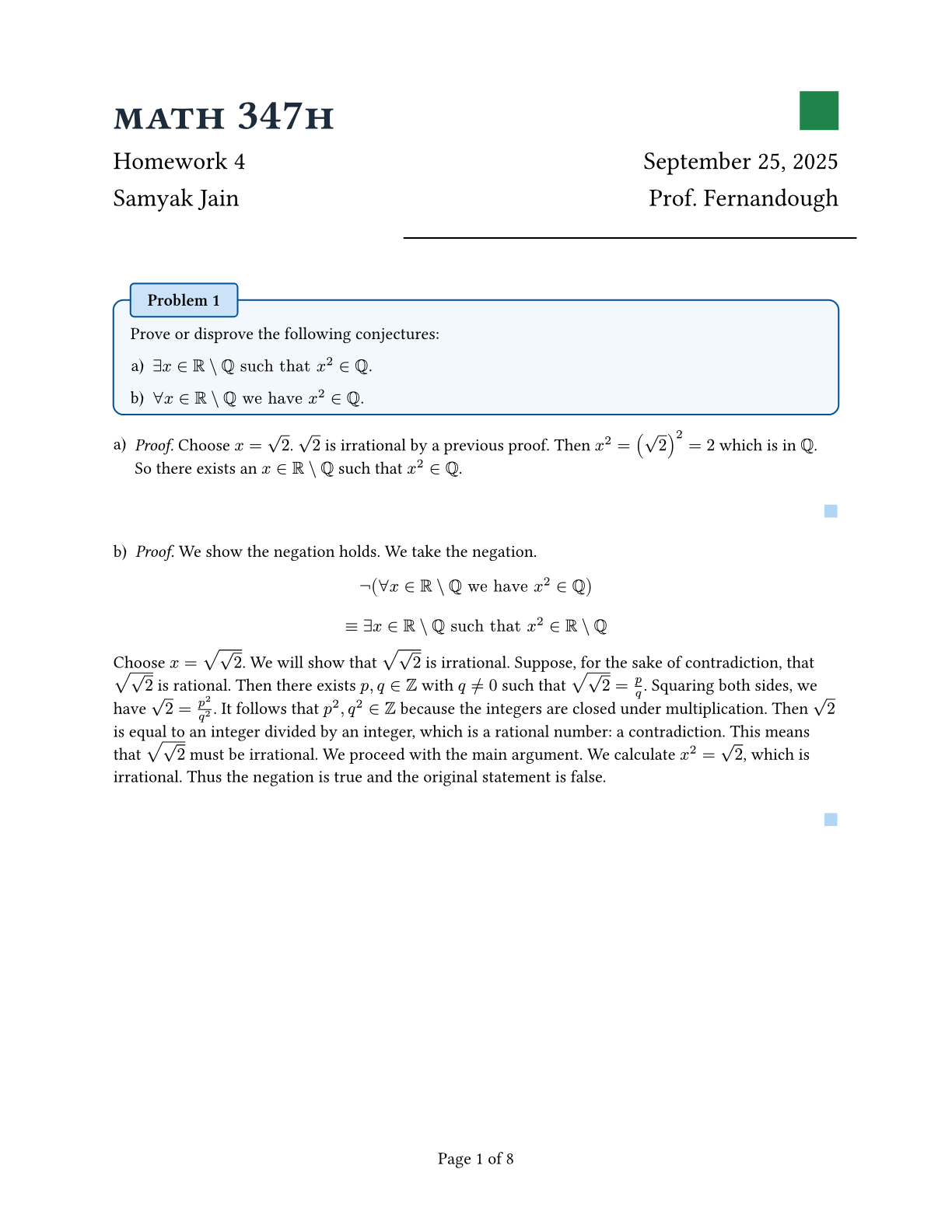
Example front page
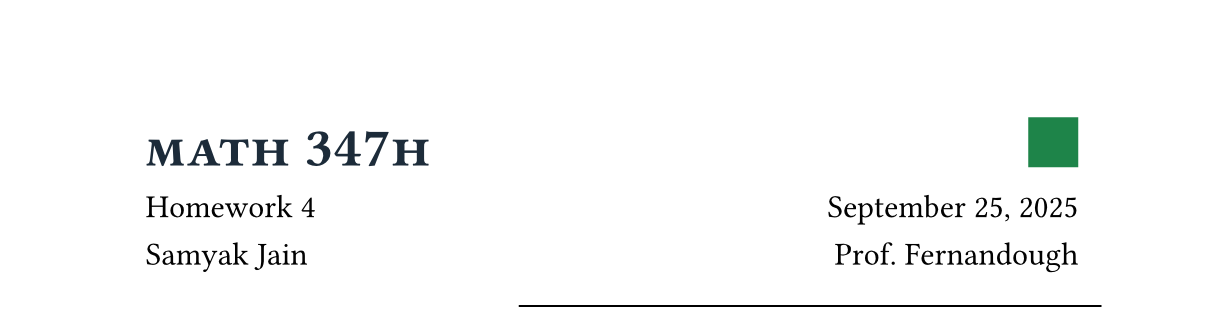
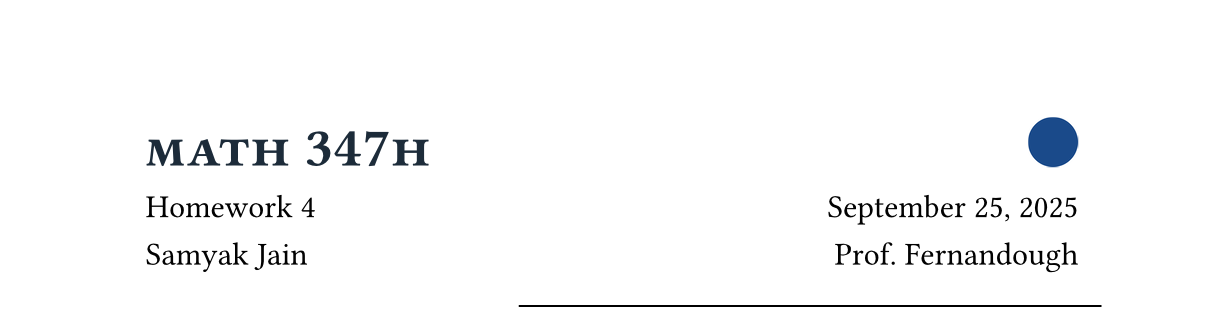
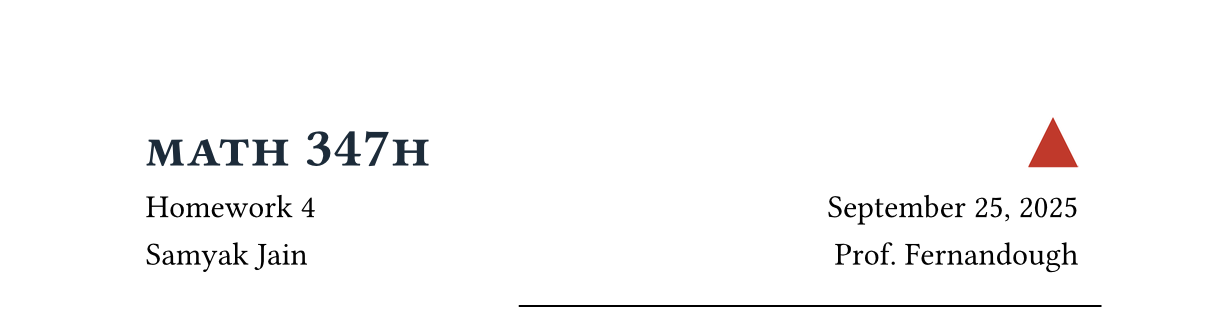
Example logo integrations
Logos
The example images use placeholder logos. To use your own logo, obtain it from your institution and pass it as an image:
#let logo = image("your-logo.png", height: 25pt)
Example Code
#import "@preview/nova-pset:0.1.0": *

#let class = "math 347h"
#let assignment = "Homework 4"
#let author = "Samyak Jain"
// To use a logo, add an image to this folder and replace none:
// #let logo = image("your-logo.png", height: 25pt)
#let logo = none
#let instructor = "Prof. Fernandough"
#let semester = "Fall 2025"
#let due-time = "September 25, 2025"

#show: homework.with(
  class: class,
  assignment: assignment,
  author: author,
  logo: logo,
  instructor: instructor,
  semester: semester,
  due-time: due-time,
  paper-size: "us-letter",
  accent-color: rgb("#1c2b39"),
)

#set enum(numbering: "a)")

#q(title: "Problem 1")[
    Prove that the composition of two surjective functions is surjective.
]

#b() Suppose that $f : A -> B$ and $g : B -> C$ are surjective functions. Then the composition $g compose f : A -> C$ is $g compose f (a) = g(f(a))$. We claim that $g(f(a))$ is surjective, or that

$ forall c in C, exists a in A "such that" g(f(a)) = c $

Let $c in C$ be arbitrary. Because $g$ is surjective, we know that

$ forall c in C, exists b in B "such that" g(b) = c $

So there exists a $b in B$ such that $g(b) = c$. Then, because $f$ is surjective, we know that

$ forall b in B, exists a in A "such that" f(a) = b $

So there exists an $a in A$ such that $f(a) = b$. Then $g(f(a)) = g(b) = c$. This means that the composition $g compose f$ is surjective.

#Q()