Package Information
- Last Updated
- Minimum Typst Version
- 0.14.0
- Categories
- visualization
1. Get the package
Download the package using the TPIX CLI:
tpix get @preview/stair-division:0.1.02. Import in your Typst file
Add this to your .typ file:
#import "@preview/stair-division:0.1.0": *stair-division
Typeset synthetic division (Ruffini's rule) in Typst — the
classic three-row division box and the stacked factorization staircase.
Unlike a sign or variation table, this computes: you pass the coefficients and
the root, and it does the arithmetic and draws it — the products row, the running
sums, the boxed remainder. No more hand-building tables and quietly dropping the
middle row. No dependencies (native table).
Usage
#import "@preview/stair-division:0.1.0": ruffini, ruffini-factor

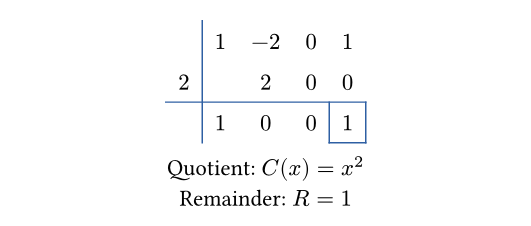
// Divide x³ − 2x² + 1 by (x − 2):
#ruffini((1, -2, 0, 1), 2)
// → three-row tableau; Quotient: C(x) = x²   Remainder: R = 1

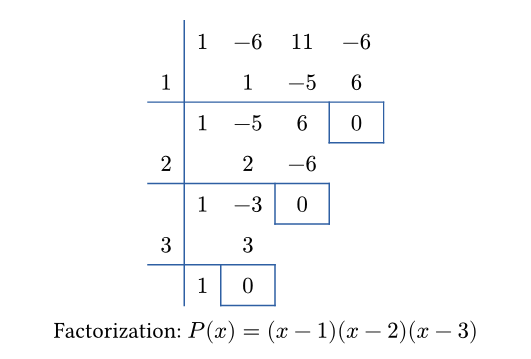
// Factor x³ − 6x² + 11x − 6 using its roots 1, 2, 3:
#ruffini-factor((1, -6, 11, -6), (1, 2, 3))
// → stacked staircase; Factorization: P(x) = (x − 1)(x − 2)(x − 3)
Coefficients go highest degree first and must include zeros for missing
terms: x³ − 2x² + 1 → (1, -2, 0, 1).
Divisor convention: root is the a in (x − a). To divide by (x + 3),
pass root: -3.
Fractions
Arithmetic is exact (rational), not floating-point, and fractions render as
fractions. You can write them two ways:
-
As a plain number — works for ordinary fractions, whose value the package
recovers exactly (even repeating decimals like1/3):#ruffini((2, -1, -1), 1/2) // root 1/2 → shows ½ #ruffini((1, 0, -3), 1/3) // root 1/3 → shows ⅓, exact #ruffini((0.25, 0.5, -1), 0.5) // decimals too → ¼, ½ -
As a string (in quotes) — always exact, no matter how unusual the
fraction. Both forrootand insidecoefficients:#ruffini(("1/2", "1/4", "-1/4"), "1/2") // fractional coefficients + root
⚠️ Use quotes for unusual fractions. A bare number goes through Typst's
floating-point first, so a fraction with a large denominator cannot be
recovered — the package then stops with a clear error telling you to quote
it (it never guesses a wrong fraction). Rule of thumb: ordinary fractions
(1/2,2/3,5/6,1/12…) work as bare numbers; anything exotic
(7/99991,355/113…) must be a string ("7/99991"). When in doubt, quote
it — the string form is always exact.#ruffini((1, 0, -3), 1/99991) // ✗ error: pass it as a string, e.g. "1/3" #ruffini((1, 0, -3), "1/99991") // ✓ exact
Variable. The rendered labels use x by default; pass variable: "t" (or any
letter) to write C(t), P(z), (t − 2), …
ruffini(coefficients, root, ...)
One division P(x) ÷ (x − root), rendered as the three-row tableau
(coefficients · products · results) with the remainder boxed.
| Parameter | Default | Meaning |
|---|---|---|
coefficients |
(required) | Array, highest degree first, zeros included. Numbers, or string fractions for unusual ones (see Fractions). |
root |
(required) | The a in (x − a). A number (-3, 1/2), or a string for unusual fractions ("7/99991"). |
lang |
"en" |
Language of the rendered words: "en" or "es". |
variable |
"x" |
The polynomial's variable in the rendered labels. |
color |
blue | Accent color of the L-rule and the remainder box. |
show-result |
true |
Append the Quotient / Remainder line. |
highlight-remainder |
true |
Draw the box around the remainder cell. |
trail |
false |
Overlay teaching arrows (see below). |
Explaining the algorithm (trail)
trail: true overlays the arrows that show how synthetic division works —
bring the first coefficient down, multiply by the root (the ×a
diagonals), add the column (the + signs) — so it doubles as a lecture
figure. Drawn natively (no CeTZ). Best with integer coefficients.
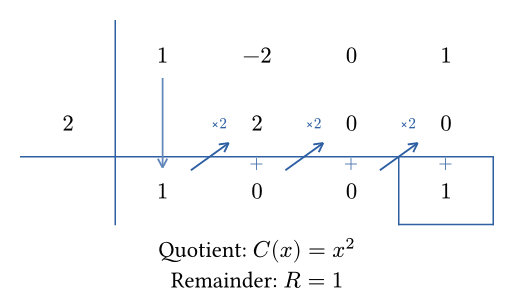
#ruffini((1, -2, 0, 1), 2, trail: true)
ruffini-factor(coefficients, roots, ...)
Applies several roots in turn — each quotient becomes the next dividend — and
draws the stacked staircase. If every division is exact, it appends the
factorization; otherwise it says so.
| Parameter | Default | Meaning |
|---|---|---|
coefficients |
(required) | Array, highest degree first, zeros included. |
roots |
(required) | The successive values a to divide by, in order. Ints or string fractions. |
lang |
"en" |
"en" or "es". |
variable |
"x" |
The polynomial's variable in the rendered labels. |
color |
blue | Accent color of the rules. |
show-result |
true |
Append the Factorization line. |
highlight-remainder |
true |
Box each division's remainder cell. |
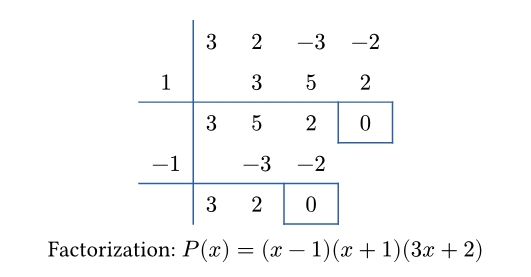
The factorization keeps the leading coefficient correct and, when an irreducible
factor of degree ≥ 2 remains, shows it in parentheses — e.g.
P(x) = (x − 1)(x + 1)(3x + 2) or P(x) = (x − 2)(x² + x + 1).
What it handles
| Case | Behavior |
|---|---|
| Exact division | Remainder 0, boxed; quotient shown. |
| Nonzero remainder | Boxed remainder; R = … in the result line. |
| Missing terms | Handled via the explicit zero coefficients you pass. |
| Fractional root / coefficients | Exact rational arithmetic; rendered as fractions. Bare numbers for ordinary fractions, strings for unusual ones. |
| Leading coefficient ≠ 1 | Preserved through the staircase and in the factorization. |
| Irreducible quotient | ruffini-factor stops and shows (…) for the remaining factor. |
| Supplied value is not a root | ruffini-factor reports "not an exact division". |
Localization
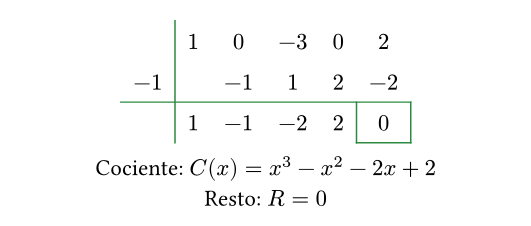
Rendered words default to English. Pass lang: "es" for Spanish
(Cociente / Resto / Factorización). Adding a language is copying one block in the
_i18n dictionary in lib.typ and translating four words — contributions welcome.
Compatibility
- Typst
>= 0.14.0 - No dependencies.
Known limitations
See ROADMAP.md. In short: it does not find the roots for you
(you supply them — that is a root-finding problem, not a layout one), and it
divides only by linear binomials (x − a), which is what Ruffini's rule is for.
License
MIT.