Package Information
- Last Updated
- Minimum Typst Version
- 0.15.0
- Authors
- Jason Siefken
- Categories
- utility
1. Get the package
Download the package using the TPIX CLI:
tpix get @preview/xmlit:0.1.32. Import in your Typst file
Add this to your .typ file:
#import "@preview/xmlit:0.1.3": *typst-xmlit
Tools for generating, validating, and outputting XML using Typst syntax.
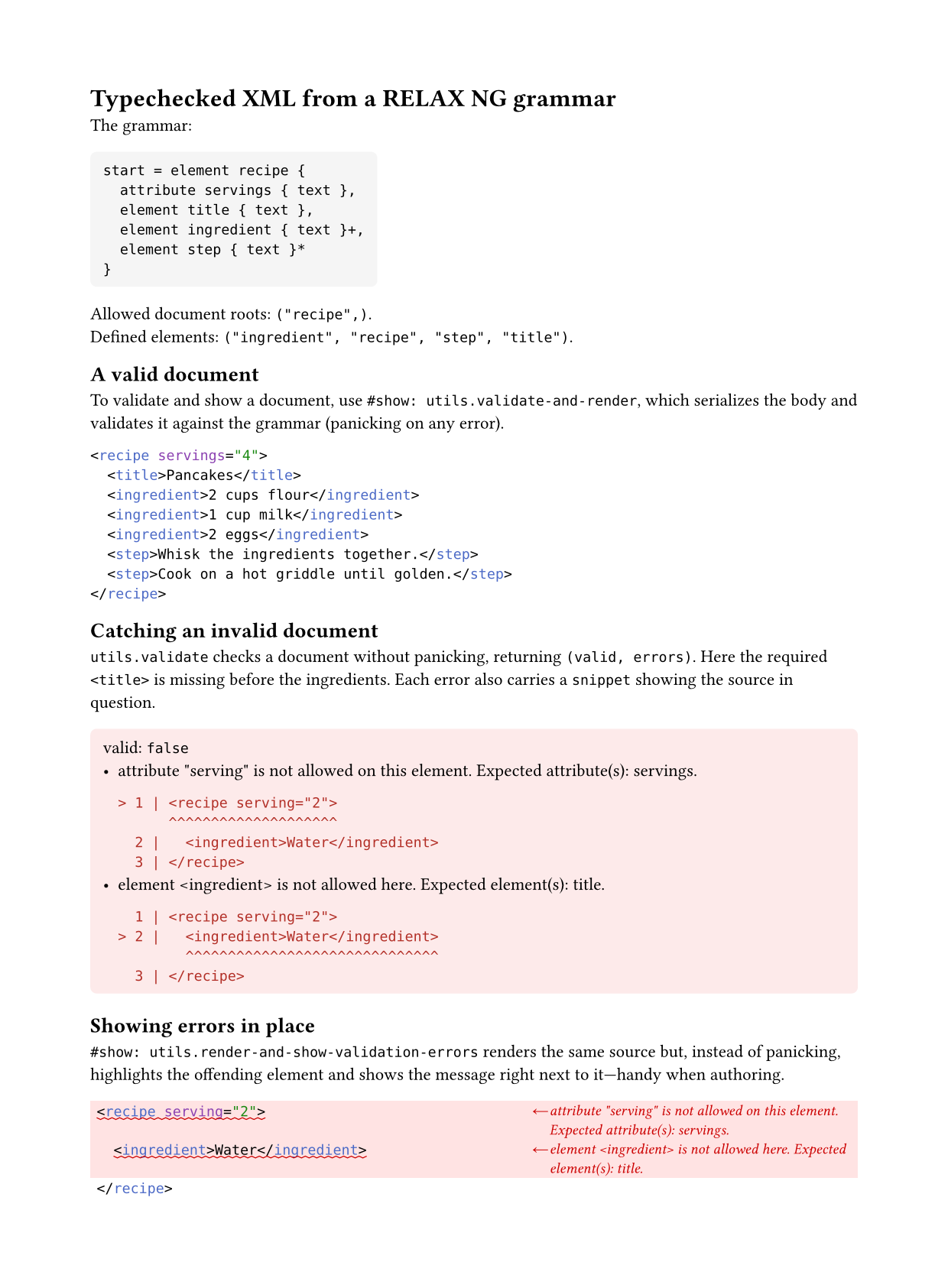
The page above is examples/create-from-relaxng.typ
rendered by Typst: it derives typechecked element constructors from a RELAX NG
grammar, then validates and prints a document — pointing right at the mistakes
in an invalid one.
Authoring XML
Create functions which return XML elements with make-tag/make-tags.
Use the resulting functions using standard typst syntax. Named arguments are converted to attributes and positional arguments
are treated as children.
make-tag(tag, handlers: auto) -> function
Creates a tag function for a single element named tag. handlers overrides
how body content is converted to XML (see Markup in bodies).
The returned tag function takes named arguments as attributes and positional
arguments as children: <tag>(..args) -> content.
make-tags(..names, handlers: auto) -> array
Creates one tag function per name, returned in order for destructuring;
handlers is forwarded to each.
#import "@preview/xmlit:0.1.3": make-tags, xml-to-string

#{
  let (foo, bar) = make-tags("foo", "bar")

  // Typst native XML parsing
  let xml1 = xml(bytes(`<foo><bar baz="zz" />text</foo>`.text))

  // Construct XML by passing using function arguments
  let xml2 = foo(bar(baz: "zz"), "text")

  // Construct XML by passing using a code block
  let xml3 = foo({
    bar(baz: "zz")
    "text"
  })

  // Construct XML by passing content
  let xml4 = foo[#bar(baz: "zz")text]

  [
    // All versions render as `<foo><bar baz="zz" />text</foo>`
    #xml-to-string(xml1)

    #xml-to-string(xml2)

    #xml-to-string(xml3)

    #xml-to-string(xml4)
  ]
}
Markup in bodies
Inside content ([...] blocks) markup is automatically converted into tags:
*bold*→<b>bold</b>_emph_→<em>emph</em>`code`→<c>code</c>$x^2$→<m>x^2</m>$ ... $→<md>…</md>
This mapping can be overwritten by providing handlers to the make-tag function.
#import "../src/lib.typ": *

#let p = make-tag("p", handlers: (
  // strong -> <alert> instead of <b>
  "strong": (c, convert, ctx) => ((tag: "alert", attrs: (:), children: convert(c.body)),),
  // Control how the _content_ of math is serialized.
  "math": (body, convert, ctx) => ("MATH: \"" + repr(body) + "\"",),
  // Control what tag is used for math blocks.
  "equation": (c, convert, ctx) => {
    let f = c.fields()
    let tag = if f.block { "md" } else { "m" }
    // Use the math handler we defined already.
    let math-handler = ctx.handlers.at("math")
    ((tag: tag, attrs: (:), children: math-handler(f.body, convert, ctx)),)
  },
))

// Becomes: `<p>A <alert>very important</alert> point about <m>MATH: "attach(base: [x], t: [2])"</m>. It can sometimes be solved with <md>MATH: "root(radicand: [⋅])"</md></p>`
#xml-to-string(p[
  A *very important* point about $x^2$. It can sometimes be solved with
  $
    sqrt(dot)
  $
])
A handler has the signature handler(element, convert, ctx)
convertturns any child value (e.g. the element's body) into an array of XML nodes using the
same handler tablectxprovides an object that can be used to look up other handlers that are defined. They will be defined onctx.handlers.
Unmapped markup (e.g. headings) raises an error naming the element and the
handlers: entry that would map it.
Preserving Math
There is no way (in typst 0.15) to serialize all math such that eval
can evaluate it as valid typst code. Since you may want access to the math (for example,
measure it), the extract-math: true option may be passed to xml-to-string.
If passed, it returns a dictionary (xml, math-items): all found math is
collected into math-items and the math in the XML string is replaced with a
sentinel.
#let (xml, math-items) = xml-to-string(doc, extract-math: true)
// xml:        "<p>Area: <m>⟦math-0⟧</m></p>"   (text sentinels, ⟦id⟧)
// math-items: ("math-0": $pi r^2$, ...)         (real equation content)

// rendered sizes, keyed by the same ids that appear in the XML:
#context math-items.pairs().map(((id, eq)) => (id, measure(eq)))
Ids are assigned in document order ("math-0", "math-1", ...), so they are
deterministic across compiles. The default (no extract-math).
See examples/render-xml-with-math.typ for an example where
xml is produced with math rendered as "math" via typst.
Typechecked authoring from a RELAX NG grammar
create-from-relaxng(rnc, handlers: auto, wasm: auto) -> dictionary
create-from-relaxng derives tag functions from a RELAX NG grammar (compact
syntax, .rnc) and validates the composed document via a bundled WASM
plugin (see plugin/). It returns
(elements: dictionary, utils: dictionary). Parameters:
rnc— the grammar source (str/bytes), or a(file-name: contents)
dictionary for multi-file grammars (the first entry is the entry point).handlers— forwarded to every generated tag function.wasm— the validator plugin; defaults to the bundled one.
#import "@preview/xmlit:0.1.3": create-from-relaxng

#let (utils, elements) = create-from-relaxng(
  "start = element foo { element bar { attribute baz { text } }* }",
)
#let (foo, bar) = elements

#show: utils.validate-and-render

#foo[#bar(baz: "xx")]
The returned dictionary destructures into two entries:
elements— a dictionary mapping each element name defined in the grammar
to its tag function (destructure the ones you need, as above).utils— grammar-level helpers, each acceptingpretty-print: falsewhere
applicable (see Pretty printing):-
render(body, pretty-print: false) -> content— a template
(#show: utils.render) that serializes its body and renders the XML
source without validating. Useful for fast iteration; switch to
validate-and-renderonce the document is ready to be checked. -
validate-and-render(body, pretty-print: false) -> content— a template
(#show: utils.validate-and-render) that serializes its body, validates
it against the grammar, and renders the XML source. Invalid documents fail
compilation with a readable panic that includes a small line-numbered
snippet of the source around each error, not the whole document:XML failed RELAX NG validation: - element <qux> is not allowed here. Expected element(s): bar. 1 | <foo> > 2 | <qux /> ^^^^^^^ 3 | </foo>No
(line, column)is shown — those would be positions in the invisible,
internally-generated compact XML string, not anything actually written.The snippet is windowed both by line (a couple of lines of context) and,
within the target line itself, by character count — pretty-printing only
breaks lines between all-element children, so a<p>full of prose (or
even a whole document with no element-only nesting) can pretty-print to
one very long line; the character-level window is what keeps the snippet
short regardless.Use
.with(pretty-print: true)in a show rule:
#show: utils.validate-and-render.with(pretty-print: true). -
render-and-show-validation-errors(body, pretty-print: true) -> content—
a template (#show: utils.render-and-show-validation-errors) for
authoring/preview: likevalidate-and-render, but instead of panicking on
an invalid document it renders the XML source anyway, highlighting each
offending element's line in place with its error message. Errors that
can't be tied to a specific element are listed below the block. Useful
while iterating on a document you know isn't finished yet. -
validate(doc) -> (valid: bool, errors: array)— validate content or an
XML string without panicking. On failure, each entry inerrorsalso
carries asnippet— the same windowed source excerpt used in
validate-and-render's panic message (noneonly for errors with no
locatable position, e.g. an internal buffer-limit error). For a rawdoc
string the snippet windows directly around the error's position in that
string (no round-trip through the grammar needed), and the plugin's raw
line/columnfields are kept, since they index the exact string
written. For authored content the snippet is mapped through the element
that produced it, andline/columnare removed — those would be
positions in an invisible, internally-generated XML string, not anything
actually written, so they'd only mislead. -
roots— the element names allowed as the document root. (All element
names areelements.keys().)
-
A handlers: argument passed to create-from-relaxng is forwarded to every
generated tag function, so one handler table configures markup/math
conversion for the whole grammar (see Markup in bodies).
Serializing
xml-to-string(node, handlers: auto, extract-math: false, pretty-print: false) -> str | dictionary
xml-to-string accepts authored trees (the return value of a tag function or
any markup content), plain node dictionaries/strings/arrays, and — faithfully —
the output of Typst's built-in xml() reader. Parameters:
node— an authored tree, a node dict/str/array, orxml()reader output.handlers— overrides for content conversion (see Markup in bodies).extract-math— return a(xml, math-items)dictionary with equations pulled out (see below).pretty-print— indent element-only content (see below).
#xml-to-string(xml("doc.xml"))
Attribute order is preserved, text/attribute contexts are escaped correctly,
empty elements self-close, and default-namespace declarations are re-emitted
only where the namespace actually changes.
Pretty printing
Pass pretty-print: true to indent the output. Only elements whose children
are all elements are reflowed — one child per line; elements containing any
text (mixed content) stay inline, so no significant whitespace is introduced:
#xml-to-string(root(a(b()), b(id: "2")), pretty-print: true)
// <root>
//   <a>
//     <b />
//   </a>
//   <b id="2" />
// </root>

#xml-to-string(p[Some *bold* text], pretty-print: true)
// <p>Some <b>bold</b> text</p>   (mixed content — left inline)
Pretty-printed output is meant for reading; it is not byte-faithful to
xml() reader input.